Interview
Project Grayburn: inside the mind of BDT UK
Project Grayburn will replace the ageing SA80-series assault rifles operated by the UK, with timelines and acquisition scale key. Richard Thomas reports.

Jack Cadman, Beretta Defense Technology UK’s military group manager
The British military has been soldiering on with the SA80-series rifle for 40 years contending with the curious foibles and traits of an imperfect system as growing obsolescence threatens its efficacy on the battlefield.
In a bid to finally replace the battle rifle with a weapon more suited to contemporary conflict, the UK Ministry of Defence initiated Project Grayburn, a programme that is critically needed but still some way short of fruition.
Global Defence Technology speaks with Jack Cadman, Beretta Defense Technology UK’s military group manager, on the company’s pitch for Project Grayburn and some of the key factors that will determine the once-in-a-generation decision.
Richard Thomas: How have infantry battle rifles evolved and what sort of capabilities are now required in the modern battlefield?
Jack Cadman: Where we have seen the greatest development in technology in recent times is in the weapon sight/optic. Target acquisition is the most vital component of modern marksmanship in a warfighting scenario, with the phrase often being said by MoD representatives that ‘the rifle is an ancillary to the optic’.
Additionally, there is an increasing emphasis for modern rifles to reduce infrared and visible signatures and the modern soldier must be able to operate in urban, rural, and asymmetric environments, and increasingly under surveillance or drone threat.
The SA80 is no longer viable for modern conflict, with its inability to be upgraded and reliability issues meaning that it is not suitable for the requirements of contemporary warfare. The fact that it can only be fired right-handed puts the British military at considerable disadvantage when using it.
As the Nato standard, 5.56mm is still a very effective ammunition type due to it being lightweight enough to equip soldiers with enough ammunition carried on the person and also having a low recoil allowing for accurate rapid fire.
Also, 5.56mm also benefits from being in production for a sustained period which means economies of scale and optimisation of the round have fully evolved – important when looking at the economy of warfare. The effect it has on barrel wear is also a pertinent consideration. It has proved effective in Ukraine and remains the calibre choice of our Nato allies.
However, as a representative manufacturer, BDT UK can’t tell the MoD what calibre they should choose. While the capability requirements for Project Grayburn are still being defined, if you look at other countries within Nato, including France, Germany Finland, and Sweden, they’ve all decided on the 5.56mm.
Richard Thomas: What opportunities does BDT UK foresee with Project Grayburn?
Jack Cadman: BDT UK sees Project Grayburn as the kickstarter programme to a strategic partnership with the UK MoD for domestic small arms manufacturing. Whilst Project Grayburn represents an initial requirement for 180,000 individual weapon systems, the opportunity which this leads onto is the real win for UK strategic security objective and the defence sector.
The current out of service date for the SA80A2 is 2030, with the A3 variant being 2040, which gives an idea of the procurement timeline. The Minister for Defence Procurement and Industry [Maria Eagle], recently confirmed that Project Grayburn remains in the concept phase, but we understand that further updates may be outlined in the Defence Investment Plan being published later this year.
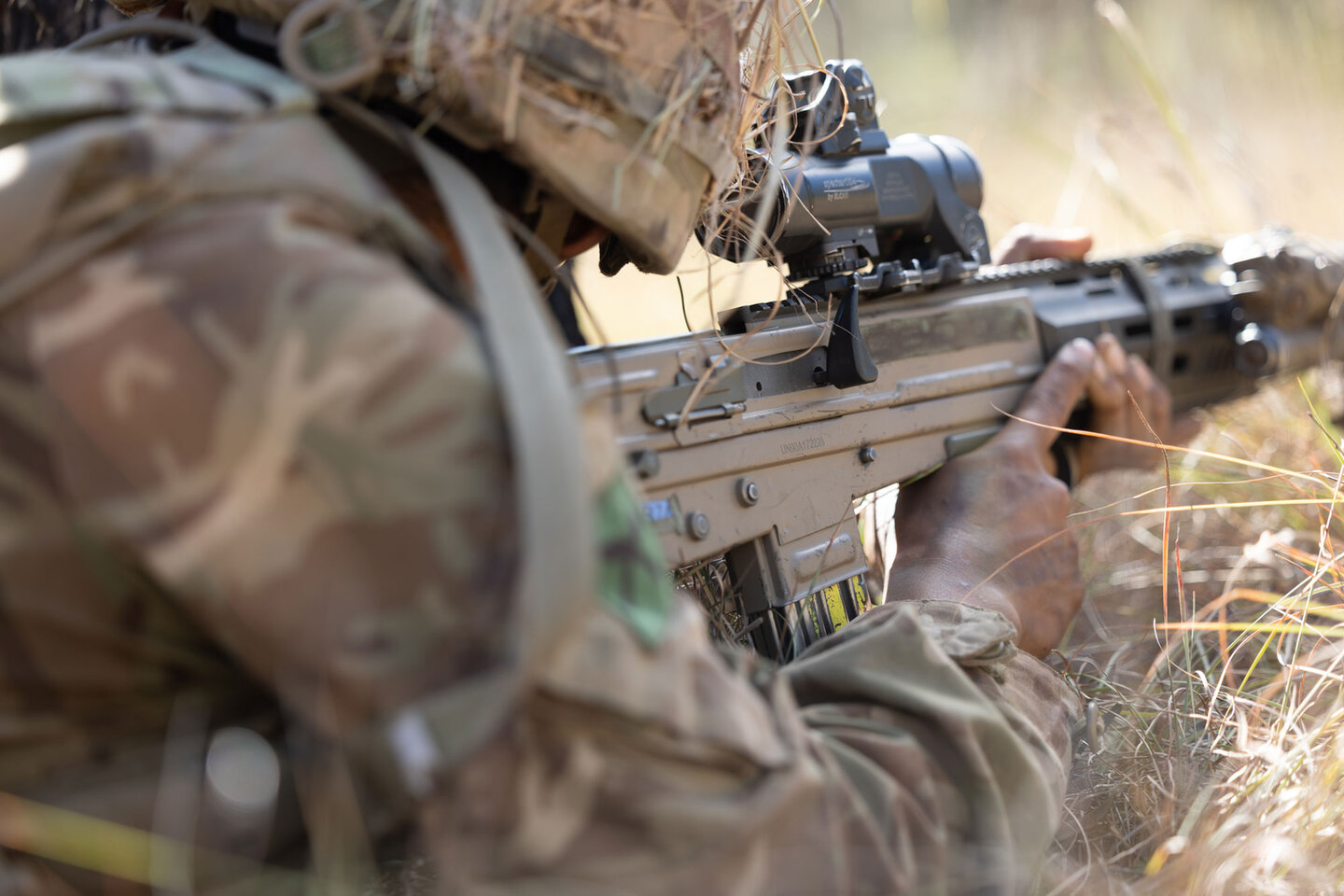
The UK is exploring options to replace its legacy SA80-series assault rifle. Credit: UK MoD / Crown copyright

The mine’s concentrator can produce around 240,000 tonnes of ore, including around 26,500 tonnes of rare earth oxides.
Gavin John Lockyer, CEO of Arafura Resources
Given the targeted tenfold increase in the lethality of the British Army that was set out in the Strategic Defence Review, we would hope to see a more established timeline for Project Grayburn as well as a clear intent from the MoD over the requirement for the rifle to be procured within the UK. This is important as while there will be a strong push for all Grayburn competitors to build the rifle within the UK, the financial feasibility of this will depend on the demand signal from the MoD.
For example, given a demand signal that allows for full investment in the UK, BDT UK is able to produce all components within the UK at cost. However, if the MoD only request a low number of weapons and demand that they be manufactured in the UK, then the costs become unfeasible.
As a former British Army officer, I am concerned about equipping our soldiers with kit that is no longer viable for modern warfare. We all remember the scandals of sending soldiers to Iraq and Afghanistan without the required equipment, and given survival often depends on the rifle in your hands, our Armed Forces must be equipped with weapons that are effective and reliable against our adversaries.
Richard Thomas: Is BDT UK able to state what rifles it is considering putting forward for Project Grayburn, and if so, what makes these rifles applicable?
Jack Cadman: BDT UK is in the unique position that it is able to supply two weapons – the Sako AR and Beretta NARP. Additionally, being within the BDT umbrella, Steiner is able to produce optics, streamlining operations and reducing costs associated to distributors.
Beretta’s NARP is an advanced platform designed to increase and enhance five key operational capabilities: lethality, reliability, ergonomics, modularity, and signature production. The NARP’s proprietary trigger brings reliability and endurance to the rifle, differing it to anything else in the market.
Sako is Finland’s oldest and most established firearms manufacturer. In 2023, Sako’s AR was procured by the Finnish and Swedish Armed Forces under an initial ten-year contract, with it expected to be extended beyond that period.
Meanwhile, Steiner produces a range of weapon optics designed to facilitate precision and reliability for weapons that require a range of effects. BDT UK is the only supplier with firearms, optics, and ancillaries within its group, offering the MoD a fully integrated supply chain and a single point of contact for its procurement.
Richard Thomas: What sort of UK-based industrial capacity could be created to sustain any UK programme with BDT UK?
Jack Cadman: In 2001 when the Royal Ordnance Nottingham Small Arms Factory closed, the UK lost its capacity to manufacture small arms at scale. BDT has a proven track record of establishing indigenous manufacturing capabilities, demonstrated by the Beretta M9 contract with the US Department of Defense and the rapid creation of Bindig in Qatar.
BDT UK’s strategy for Project Grayburn offers significant benefits to the UK, generating high-skilled jobs in the Midlands through its state-of-the-art manufacturing facility in Faldingworth, Lincolnshire. The key for BDT UK is to develop a strategic partnership with the UK for all small arms weapon platforms born from the initial development of a UK made rifle.
However, the industrial capacity that can realistically be onshored to the UK through Project Grayburn is dependent on the requirements set out by the MoD. The number of weapons required per year by UK defence will directly impact the costs of each weapon system, and therefore the level of industrial localisation that is feasible.
With the business spanning the whole small arms spectrum given a full demand signal from the MoD, BDT UK is ready for all rifle components, including the barrel, to be manufactured at its production facility.
This option will deliver the ultimate return for national capability and economic impact, generating a maximum number of UK jobs and providing strategic independence and supply chain resilience for the entire production and life cycle of the weapon system.
