Feature
Reformation Act: US plots acquisition change
Can the SPEED and FoRGED Acts bring meaningful change to US military procurement? Jen Kirby reports.
Main image: The US is eyeing record defence spending levels. Credit: Pixabay
Cover Story
Eye in the sky
As the first line of threat detection, airborne early warning is a must-have capability for the world’s militaries. Gordon Arthur reports.

Australia was the first country to adopt the E-7A Wedgetail. Credit: Gordon Arthur
This July, at the American Institute of Aeronautics and Astronautics' ASCEND conference in Las Vegas, the United States Space Force’s Lt. General Philip Garrant was asked about his vision for equipping the Guardians of the future.
Garrant, who leads Space Systems Command, brought up two defence reform acquisition bills recently introduced in the US Congress, the SPEED and FoRGED Acts. A version of this legislation is likely to be part of the more than $800 billion Fiscal Year 2026 National Defense Authorization Act (NDAA).
“We actually welcome some of those ideas. They are groundbreaking,” Garrant said about bills. “I’ve heard the [acquisition] reform that we’re going to see out of the ‘26 NDAA compared to Goldwater-Nichols of the ‘80s. It’s that fundamentally changing,” Garrant added, referring to the landmark 1986 law that reorganised the US Defence Department.
The House of Representative's SPEED (Streamlining Procurement for Effective Execution and Delivery) and the Senate’s FoRGEd (Fostering Reform and Government Efficiency in Defense) Acts are responding to bipartisan complaints from policymakers, the defence and tech industry, and inside and outside the US military that the Pentagon’s current approach to acquisitions and procurement is too slow and too cumbersome. They argue this wastes money and prevents the US from quickly adopting new technologies to meet emerging threats.
The SPEED and FoRGED Acts offer different approaches on how to overhaul the current system, which lawmakers in the House and Senate will need to reconcile in the final version of the NDAA, likely to be approved by the end of the year. Combined with President Donald Trump’s executive orders on modernising defence acquisitions and the federal contracting process, this legislation aims to reduce regulatory burdens and build a more flexible requirements system to speed up innovation. The legislation also pushes the Pentagon to rely on commercial solutions, which would bring in more nontraditional defence contractors.
“We cannot afford to continue on the path of business as usual,” Chairman Rep. Mike Rogers (R-MI) and Ranking Member Rep. Adam Smith (D-WA) of the House Armed Services Committee wrote in a June op-ed in The Military Times about their bipartisan SPEED Act.
“It is time to reform how the Pentagon buys weapons so that we can harness the United States’ unmatched innovation and dynamic private sector and deliver the capabilities that service members need.”
This legislation is far from the first effort to transform how – and how fast – the Pentagon fields its warfighting capabilities. But the energy behind this latest attempt comes as the US seeks to develop artificial intelligence-enabled and space-based capabilities and outmatch and outpace China.
Russia’s invasion of Ukraine has also shown how rapidly the modern battlefield evolves. A relatively inexpensive off-the-shelf drone may be more effective than a multi-million-dollar main battle tank – and far easier to abandon when a new capability makes it obsolete. Across the Pentagon, Defence Secretary Pete Hegseth has pushed to invest in more advanced capabilities and cheaper, more adaptable tech. These legislative reforms fit with this administration’s vision.
Advocates say the SPEED and FoRGED Acts will make the Pentagon more agile and give it a technological edge through collaboration with many more firms. Some government watchdogs and experts have criticised certain provisions, arguing the emphasis on speed could lead to riskier acquisitions and increased costs for taxpayers.
But whatever version of the SPEED and FoRGED Acts ends up in the NDAA, whether it will deliver on its promises will hinge on how effectively the Pentagon implements these reforms.
“It's one thing to write the law and to do the policies. It's another to teach and train and give a generation of people the experience they need to actually do it,” said Peter Newell, a former director of the US Army’s Rapid Equipping Force (REF) and current CEO of BMNT, a government innovation consulting firm.

The DroneGun Mk4 is a handheld countermeasure against uncrewed aerial systems. Credit: DroneShield
SPEED v. FoRGED
Both the SPEED and FoRGED Acts are different but complementary approaches to reforming the US military's acquisition and requirements process and strengthening the defence industrial base and national supply chains.
The bipartisan SPEED Act streamlines and refurbishes the current acquisitions framework. The Senate’s FoRGED ACT, first introduced by Senate Armed Services Committee Chairman Roger Wicker (R-MS), was a much more dramatic remodeling, though not all of its initial provisions ended up in the Senate’s version of the NDAA.
Tim Brennan, vice president of government relations at the Professional Services Council told the Federal News Network in August that the Senate’s approach was “almost like spring cleaning for acquisition.”
Both proposals shift to a more portfolio-based approach to acquisitions. The idea here is to emphasise the mission over rigid, programme-specific requirements. “It’s not Nirvana,” as one defence acquisition professional put it, but “right now that flexibility doesn't exist.”
This supports the legislation’s efforts to increase the Pentagon’s use of commercial products and firms. Congress has attempted to legislate this before, including with the 1994 Federal Acquisition Streamlining Act (FASA).
Advocates of the SPEED and FoRGED Acts see them as a way to finally enforce these requirements. “What you've seen over time is, it used to say, ‘you can.’ Now it says, ‘you will’ – you can use commercial things versus you will use commercial parts, and we're holding a standard,” Newell said.
Proponents of this approach, especially with high-tech fields like artificial intelligence, see this as a way to solicit new partners and test out new technology so when new threats emerge, the military knows how to respond.

The US Congress is seeking to push through reforms. Credit: Volodymyr TVERDOKHLIB/Shutterstock.com
This is a “dynamic inflection point where behavior can actually change and flip so that the Department of Defense becomes a smart buyer of commercial items, works cooperatively with private capital for the first time, instead of antagonistically, and creates a marketplace of multiple competing vendors,” said Warren Katz, chairman of the Alliance for Commercial Technology in Government, whose organisation supports the reforms.
The apparent goal is for the US military to succeed – or fail – faster. The Pentagon can shop around and test products or capabilities to see if they fit operational requirements. If it does, then the Pentagon has something it can quickly plug-in or build on. If it does not, it can move on. “The time to switch has to be crushed down to nothing,” Katz said.
To fulfill this vision, these bills seek to cut back on regulations for defence contractors. “By exempting new defence contractors from burdensome defence-specific rules, we keep them innovative and hungry,” Wicker, the architect of the FoRGED Act, wrote in aWashington Post op-ed with Katherine Boyle, a partner at the firm Andreessen Horowitz.
“These are the firms that can accelerate adoption of new technology. Traditional prime contractors will benefit as well; they will be able to trim compliance layers, escaping a culture of box-checking,” Wicker and Boyle argued.
Yet Congress itself creates these regulations for a reason. While most agree it shouldn't take years to bring new capabilities online, some have cautioned that the drive for speed puts more power in the hands of contractors, which risk cost overruns and bad deals. For example, the legislation has proposed changes to cost accounting practices, which proponents say makes it less risky for commercial firms to do business with the government.
Others argue it could allow contractors the opportunity to overcharge, leaving the government with little recourse to recoup losses – that is, taxpayer money. “Contractors want the fastest, fastest system possible that's going to give them the maximum amount of the award and profit,” said Scott Amey, general counsel of the Project of Government Oversight.
The bipartisan $800bn FY26 NDAA is still weaving through Congress. Combined with defence provisions in the One Big Beautiful Bill Act Trump signed into law in July, the Pentagon’s budget will hit $1 trillion. There is a lot of money to go around, for the prime defence contractors, but potentially for a whole host of new firms.
Proponents of acquisition reform want to ensure more of this money goes to innovating capabilities for America’s warfighters. As Newell said, the goal is mission acceleration, at scale. “That's what we have to be able to do no matter what the next war is,” he said. “It’s less about buying the tech than it is about the process of getting the tech.”

Russia has learned how to use its helicopters not just better, but far more effectively.
Lt Col Emiliano Pellegrini, Nato
To modernise the platform, via an April request for information, the USAF is canvassing the inclusion of a new radar, electronic warfare equipment and enhanced
communications to create an “Advanced E-7”. Two such examples are sought within seven years, after which other E-7s could be retrofitted with the modifications.
As for the UK, three 737NG aircraft are currently undergoing modification in Birmingham, the first completing its maiden flight in September 2024.
Global Defence Technology asked Boeing what makes the E-7 stand out, and a spokesperson listing three points. First is its allied interoperability. “With the aircraft in service or on contract with Australia, South Korea, Türkiye, the UK and USA – and selected by Nato – its unmatched interoperability benefits a growing global user community for integration in future allied and coalition operations.”
The US is by far the largest spend on nuclear submarines. Credit: US Navy
Country | 2024 | 2025 | 2026 | 2027 | 2028 | 2029 | 2030 | 2031 | 2032 | 2033 | 2034 |
Australia | 3,582 | 3,586 | 3,590 | 3,594 | 3,613 | 3,622 | 6,183 | 6,207 | 6,216 | 6,239 | 6,380 |
China | 2,607 | 2,802 | 3,040 | 3,081 | 3,174 | 3,291 | 3,396 | 3,603 | 3,664 | 3,710 | 4,316 |
India | 2,320 | 2,533 | 3,675 | 2,457 | 2,526 | 2,639 | 2,741 | 2,873 | 2,958 | 3,350 | 3,560 |
Russia | 2,701 | 2,893 | 2,973 | 3,334 | 3,458 | 3,106 | 3,235 | 3,405 | 2,958 | 3,487 | 3,942 |
US | 16,957 | 18,037 | 18,522 | 18,607 | 18,137 | 18,898 | 18,898 | 19,643 | 19,876 | 22,592 | 23,730 |
Lisa Sheridan, an International Field Services and Training Systems programme manager at Boeing Defence Australia, said: “Ordinarily, when a C-17 is away from a main operating base, operators don’t have access to Boeing specialist maintenance crews, grounding the aircraft for days longer than required.
“ATOM can operate in areas of limited or poor network coverage and could significantly reduce aircraft downtime by quickly and easily connecting operators with Boeing experts anywhere in the world, who can safely guide them through complex maintenance tasks.”
Boeing also uses AR devices in-house to cut costs and improve plane construction times, with engineers at Boeing Research & Technology using HoloLens headsets to build aircraft more quickly.
The headsets allow workers to avoid adverse effects like motion sickness during plane construct, enabling a Boeing factory to produce a new aircraft every 16 hours.
Elsewhere, the US Marine Corps is using AR devices to modernise its aircraft maintenance duties, including to spot wear and tear from jets’ combat landings on aircraft carriers. The landings can cause fatigue in aircraft parts over its lifetime, particularly if the part is used beyond the designers’ original design life.

Caption. Credit:

Phillip Day. Credit: Scotgold Resources
Total annual production
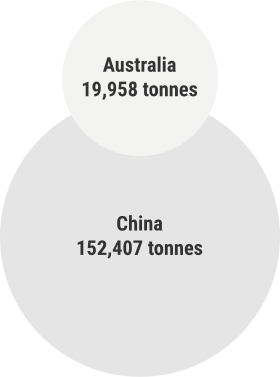
Australia could be one of the main beneficiaries of this dramatic increase in demand, where private companies and local governments alike are eager to expand the country’s nascent rare earths production. In 2021, Australia produced the fourth-most rare earths in the world. It’s total annual production of 19,958 tonnes remains significantly less than the mammoth 152,407 tonnes produced by China, but a dramatic improvement over the 1,995 tonnes produced domestically in 2011.
The dominance of China in the rare earths space has also encouraged other countries, notably the US, to look further afield for rare earth deposits to diversify their supply of the increasingly vital minerals. With the US eager to ringfence rare earth production within its allies as part of the Inflation Reduction Act, including potentially allowing the Department of Defense to invest in Australian rare earths, there could be an unexpected windfall for Australian rare earths producers.
